A practical dry-side warm-up for swimmers and triathletes
Most swimmers understand that the opening part of a session should help them warm up, yet many arrive at the pool, get changed and expect the first few lengths to do the whole job.
This is particularly common among triathletes. Swimming may be fitted around work, family life, cycling and running, so preparation can become little more than turning up and getting into the lane. That may be manageable during an easy session with a long, progressive opening set. It is less useful when lane time is limited, the session moves quickly, or the athlete has spent the previous hour sitting in a car or at a desk.
A short dry-side warm-up gives swimmers and triathletes a chance to prepare before entering the water. It does not need to be complicated, and it should not look like a separate training session. Eight to twelve minutes is usually enough.
This preparation can be especially helpful for beginners. Less experienced swimmers often need more time to settle their breathing, find their body position, and establish a rhythm. Starting cold, stiff or rushed adds another challenge to a part of the session that may already feel difficult.
The aim is simple. Enter the water feeling warmer, moving more freely and ready to swim.
What should a warm-up achieve?
A useful warm-up gradually increases body temperature, raises heart rate and increases blood flow to the working muscles. It also allows the athlete to move through some of the positions used during swimming before they begin applying force against the water.
For swimmers, this means preparing the shoulders, upper back, trunk and hips. The muscles that control the shoulder blades also need some attention, as they provide a stable base for the arms during the pull and recovery phases of the stroke.
Triathletes may arrive at the pool carrying stiffness from cycling, running, driving or working at a desk. Those who only swim once or twice each week can also find that the overhead positions used in swimming feel unfamiliar during the first part of a session.
Beginners face a slightly different problem. They may be trying to think about breathing, timing, technique, lane awareness and the session instructions all at once. A warm-up will not remove those demands, but it can mean that less of the opening set is spent simply trying to feel physically ready.
Research across sport generally supports active warm-ups before performance, although the size of the benefit varies according to the activity, the athlete and the type of warm-up used. Swimming research also suggests that warm-up can support performance, with the intensity, volume and time between warming up and swimming all influencing the result.
For our TCC swimmers and triathletes, I tend to focus on five outcomes:
increasing general body temperature
preparing the shoulders and upper back
creating movement through the trunk and hips
activating the muscles that control the shoulder blades and arms
arriving at the first length mentally switched on
That final point is easy to overlook. A warm-up creates a clear transition between arriving at the pool and beginning the session. This can be useful during early-morning sessions, after a busy working day or when a beginner feels slightly apprehensive about getting into the water.
Warming up involves more than stretching
Poolside preparation often consists of a few arm swings followed by holding one arm across the chest. Stretching may be useful where an athlete has a specific mobility restriction, but a series of long, passive stretches does not fully prepare someone to swim.
Prolonged static stretching immediately before exercise can temporarily reduce force and power, particularly when individual muscles are held at end range for longer periods. Shorter stretches appear to have less effect, especially when they are followed by active movements.
Dynamic mobility is usually more suitable before swimming. The athlete moves through a comfortable range and gradually introduces more control and speed as the warm-up progresses.
There is no need to force the shoulders into a larger range than the swimmer can manage. Pulling heavily on the joint or chasing a perfect overhead position is unlikely to improve the session. Beginners may have limited mobility, limited control or simply be unfamiliar with the position. A smaller, well-controlled movement is more useful than forcing a range they cannot maintain.
The routine should move from general activity into mobility, activation and a small amount of quicker movement where appropriate.
The TCC dry-side warm-up
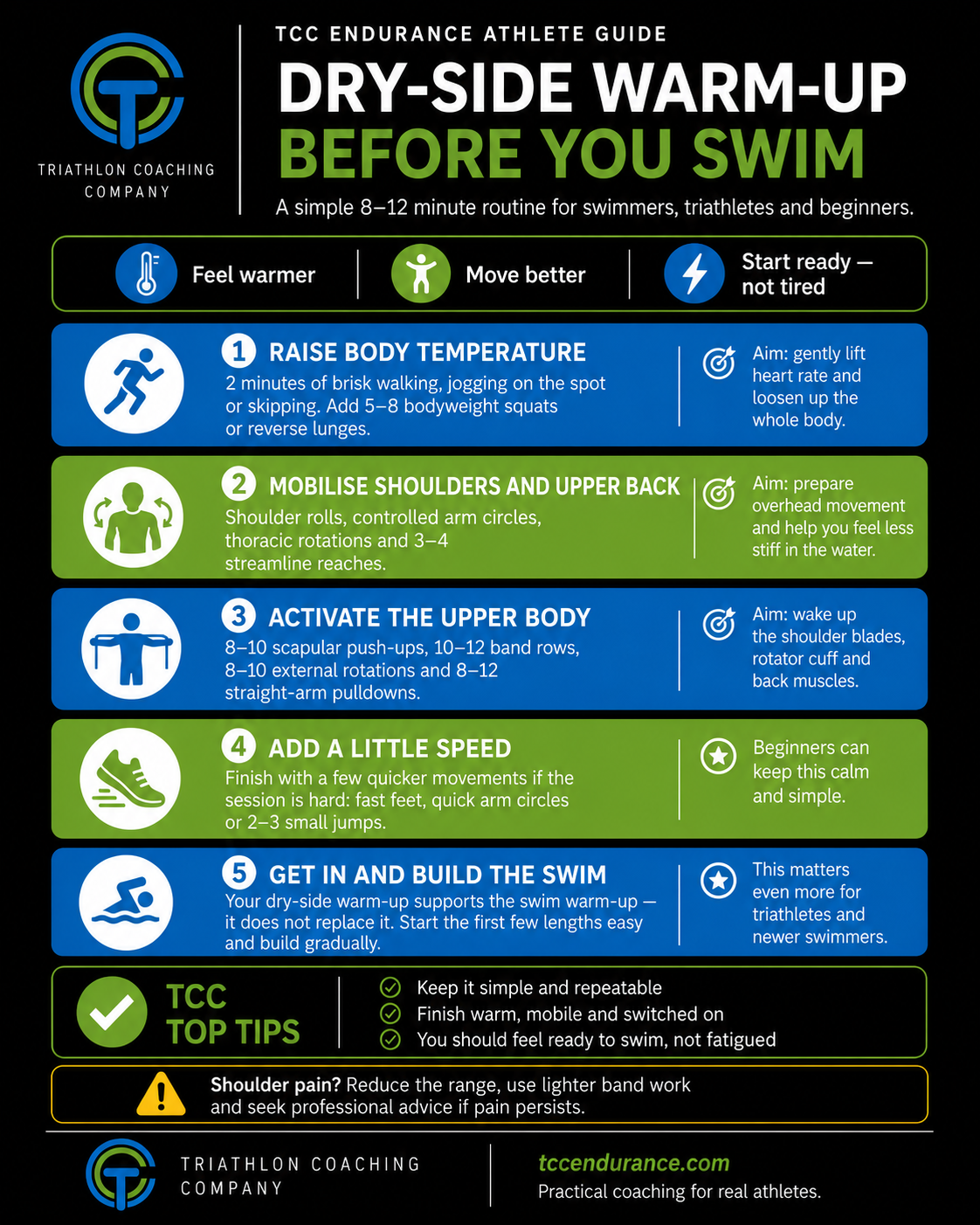
This routine takes around eight to twelve minutes. A light resistance band is useful, although much of the routine can still be completed without equipment.
Beginners do not need a completely separate warm-up. They may need fewer exercises, lighter resistance and a little more time to understand each movement. Once the routine becomes familiar, it should feel straightforward rather than becoming another set of instructions to remember.
Raise body temperature: around two minutes
Begin with brisk walking, light jogging on the spot, skipping or another simple whole-body activity.
The effort should raise the heart rate slightly without leaving the athlete breathless. Add five to eight controlled bodyweight squats or reverse lunges.
These movements prepare the hips, knees and ankles for pushing from the wall, streamlining and kicking. Swimmers sometimes overlook the lower body during a dry-side warm-up, while triathletes may feel they need to save their legs for cycling and running. The legs are still involved throughout the swim, particularly during starts, turns and changes of pace.
A beginner may only need brisk walking, marching on the spot and a few shallow squats. The movement should feel comfortable and steady.
Mobilise the upper back and shoulders: two to three minutes
Complete controlled shoulder rolls in both directions, followed by small arm circles that gradually become larger. Five to eight repetitions in each direction is enough.
Move into thoracic rotations. These can be completed standing, kneeling or from a four-point position. Rotate through the upper back while keeping the hips reasonably still. Complete around six repetitions on each side.
Movement through the thoracic spine contributes to rotation during freestyle and backstroke. Someone who is stiff through the upper back may try to create more movement through the shoulder or lower back instead.
Thoracic rotation work can be particularly useful for triathletes who spend long periods in a seated or forward-leaning position. It may also help beginners become more aware of the difference between rotating through the body and simply pulling the arm further behind them.
Finish with three or four controlled streamline reaches. Extend both arms overhead, gently lengthen through the body and hold for two or three seconds.
Avoid forcing the lower back into a large arch. The movement should come from the shoulders and upper back as far as the athlete can comfortably manage.
Prepare the shoulder blades and upper body: three to four minutes
Start with eight to ten scapular push-ups. These can be completed against a wall, on a bench or from the floor.
Keep the elbows mostly straight. Allow the shoulder blades to move around the ribcage before gently pushing the body away again.
This movement prepares the muscles that control the shoulder blades. Those muscles help provide a stable base for the arm during each stroke.
Wall-based scapular push-ups are often the best option for beginners. They are easier to control and allow the coach to see whether the athlete is moving through the shoulder blades or bending and straightening the elbows.
Follow this with ten to twelve light resistance-band rows. Draw the elbows back while keeping the shoulders relaxed and away from the ears. The movement should remain smooth.
Complete eight to ten banded external rotations on each arm. Keep the elbow close to the side of the body and use a light band. The external rotators contribute to shoulder control, although this should remain a low-level activation exercise rather than a strength set.
Finish with eight to twelve straight-arm band pulldowns. Begin with the arms slightly in front of the body and pull towards the thighs while keeping the elbows straight or only slightly bent.
This prepares the larger muscles of the back and rehearses part of the pulling action. There is no need to copy the entire swimming stroke on land.
One round is usually enough. Heavy resistance, high repetitions or repeated rounds can create fatigue before the swimmer has entered the pool.
Add a small amount of speed: one to two minutes
The final part of the warm-up should reflect the session ahead.
Before a normal aerobic or technique session, a few quicker arm circles, two short bursts of fast feet or three controlled squat jumps may be enough. Each effort should last only a few seconds.
A harder CSS, threshold or sprint session may justify two or three sharper movements. These could include quick band pulldowns, low-level jumps or light medicine-ball throws where space and equipment allow.
Beginners do not usually need explosive movements. Their main priority is to feel warm, comfortable and prepared for the water. A calm and consistent routine is generally more useful than adding speed for its own sake.
The athlete should finish this section feeling alert. They should not be breathing heavily or feeling shoulder fatigue.
Adjusting the warm-up to the session
A normal squad session only needs the basic routine. General movement, upper-back mobility and one round of band exercises will cover most of what is required. The in-water warm-up should continue the process.
Harder sessions benefit from a more progressive finish. A few faster dry-side movements can be followed by gradual increases in pace during the opening swim.
Race preparation is more individual. Pool swimmers may have access to a structured in-water warm-up, while triathletes often have less control over when they can enter the water. Some events allow a short swim before the start. Others provide little or no opportunity.
A dry-side routine becomes more valuable when an in-water warm-up is limited. It cannot reproduce the feel of the water, but it can prevent the athlete arriving at the start after standing still for a prolonged period.
Open-water races bring further considerations. Air temperature, water temperature, access to the start and delays between warming up and racing can all influence preparation.
In cooler conditions, athletes should keep additional clothing on for as long as possible. The dry-side warm-up should be completed reasonably close to entering the water, without becoming heavily sweaty and then standing around in damp clothing.
For beginners, the routine should remain familiar. Race morning is a poor time to introduce several new exercises. An open-water start can already involve nerves, colder water, close contact and a faster breathing response. Familiar preparation helps reduce some of the uncertainty.
The opening part of an open-water swim should still be controlled. A dry-side warm-up does not remove the need to enter safely, manage breathing and allow time to adjust to the water.
Shoulder pain and individual restrictions
Warm-up exercises should not be used to push through pain.
Swimmers with a history of shoulder problems may already have exercises prescribed by a physiotherapist or another healthcare professional. Those should take priority over a general routine.
Wall-based scapular push-ups may be more comfortable than floor-based versions. External rotation can be completed through a smaller range or without resistance. Arm circles can begin very small, and overhead movements can be limited when they cause discomfort.
Some muscular effort during band exercises is expected. Sharp pain, catching, instability, pins and needles or symptoms that become worse with each repetition need further attention.
Persistent shoulder pain should be assessed properly. Continually adding more stretching or more activation work is unlikely to solve an underlying problem.
The in-water warm-up still matters
Dry-side preparation supports the swimming warm-up. It cannot replace the time needed in the water.
Swimmers still need to find their stroke rhythm, breathing pattern and feel for the water. This is particularly important for triathletes and beginners, who may take longer to feel coordinated at the start of a session.
The opening part of the swim should build gradually. Easy swimming, technique work and controlled changes in pace allow the athlete to settle before harder work begins.
Coaches should also avoid assuming that everyone is ready to work at the same intensity simply because the session has started. A strong club swimmer may feel comfortable within the first few lengths. A beginner could still be managing breathing and balance several minutes later.
For group training, a dry-side routine gives everyone a better starting point. More experienced swimmers may settle into their normal stroke more quickly, while beginners may find that the opening lengths feel less abrupt.
Eight to twelve minutes is enough. Raise body temperature, create some movement, activate the shoulders and add a little speed where it suits the session. Keep the effort controlled and save the hard work for the pool. Check out our infographic below for an easy-to-follow warm-up to get you ready for a great swim session.
References
Behm, D.G., Blazevich, A.J., Kay, A.D. and McHugh, M. (2016) ‘Acute effects of muscle stretching on physical performance, range of motion, and injury incidence in healthy active individuals: a systematic review’, Applied Physiology, Nutrition, and Metabolism, 41(1), pp. 1–11.
Cuenca-Fernández, F., Boullosa, D., López-Belmonte, Ó., Gay, A., Ruiz-Navarro, J.J. and Arellano, R. (2022) ‘Swimming warm-up and beyond: dryland protocols and their related mechanisms: a scoping review’, Sports Medicine – Open, 8, 120.
Czelusniak, O., Favreau, E. and Ives, S.J. (2021) ‘Effects of warm-up on sprint swimming performance, rating of perceived exertion, and blood lactate concentration: a systematic review’, Journal of Functional Morphology and Kinesiology, 6(4), 85.
Fradkin, A.J., Zazryn, T.R. and Smoliga, J.M. (2010) ‘Effects of warming-up on physical performance: a systematic review with meta-analysis’, Journal of Strength and Conditioning Research, 24(1), pp. 140–148.
McGowan, C.J., Thompson, K.G., Pyne, D.B., Raglin, J.S. and Rattray, B. (2016) ‘Heated jackets and dryland-based activation exercises used as additional warm-ups during transition enhance sprint swimming performance’, Journal of Science and Medicine in Sport, 19(4), pp. 354–358.
McKenzie, M.R., McKean, M.R., Doyle, D.P., Hogarth, L.W. and Burkett, B.J. (2022) ‘Swimming performance, physiology, and post-activation performance enhancement following dryland transition phase warm-up: a systematic review’, PLOS ONE, 17(8), e0273248.
Neiva, H.P., Marques, M.C., Barbosa, T.M., Izquierdo, M. and Marinho, D.A. (2014) ‘Warm-up and performance in competitive swimming’, Sports Medicine, 44(3), pp. 319–330.